
Marketplace Trust
QbitMarketHub Seller Payout Readiness Setup: Stripe Connect Verification, Webhook Status, and Delivery Timing for One-Time vs Subscriptions
QbitMarketHub Seller Payout Readiness Setup: Stripe Connect Verification, Webhook Status, and Delivery Timing for One-Time vs Subscriptions
Selling AI products is not only about publishing a good listing. For a buyer to trust the purchase experience, the seller also needs payment setup, delivery expectations, refund terms, and order status handling to be clear before checkout.
QbitMarketHub is designed to help AI product sellers publish buyer-ready listings, connect Stripe, sell through marketplace checkout, and deliver practical AI products such as agents, workflows, prompts, templates, APIs, automations, and other digital assets. A key part of that flow is seller payout readiness: making sure your Stripe Connect account is prepared, your product plans are connected to checkout, and your delivery process matches the type of purchase you are selling.
This guide explains how to think about QbitMarketHub seller payout readiness setup, Stripe Connect verification, webhook-based status updates, and delivery timing for one-time purchases versus recurring subscriptions.
Why payout readiness matters in an AI product marketplace
AI product buyers often evaluate more than the product idea. They want to understand:
- Who is selling the product
- What the product does and does not include
- How long setup may take
- Whether the purchase is one-time or recurring
- What happens after payment
- How delivery is handled
- What refund or dispute options exist
For sellers, payout readiness helps reduce checkout friction and improves operational clarity. It does not guarantee sales, approvals, buyer satisfaction, or business outcomes. It simply means your seller payment setup and delivery expectations are prepared for marketplace transactions.
On QbitMarketHub, seller payments use Stripe Connect and marketplace checkout. Buyers pay through Stripe Checkout, while sellers connect Stripe to receive payouts when eligible based on the purchase type, account readiness, marketplace flow, review windows, and any applicable dispute or refund status.
Step 1: Connect Stripe before relying on marketplace checkout
The first payout readiness step is connecting Stripe. QbitMarketHub uses Stripe Connect so sellers can participate in a marketplace checkout flow without manually assembling their own payment infrastructure.
A seller should prepare to:
- Connect a Stripe account through the QbitMarketHub seller workflow
- Complete Stripe’s required verification steps
- Confirm account readiness before expecting payouts
- Create or import Stripe-backed product and price data where needed
- Match purchase plans to the correct listing offer
Stripe may require business, identity, tax, banking, or account information depending on the seller’s country, account type, and risk review. QbitMarketHub can support the connection workflow, but Stripe controls verification requirements and account status.
A practical seller habit is to treat Stripe setup as part of product launch, not something to finish after the first buyer is ready to purchase.
Step 2: Understand what “payout readiness” means
Payout readiness does not mean every payment will instantly become available. It means the seller has taken the required steps so the marketplace and payment processor can process transactions and, when eligible, release seller funds through the connected account.
In QbitMarketHub, payout readiness may depend on several factors:
- Whether the seller has connected Stripe
- Whether Stripe account verification is complete or needs more information
- Whether the product has an active purchase plan
- Whether checkout completed successfully
- Whether the order has been paid
- Whether the purchase is one-time or recurring
- Whether a review window applies
- Whether a dispute or refund is open
- Whether delivery was configured clearly for the buyer
This matters because payout timing is operational, not just financial. A seller should know when the buyer gets access, when the order status changes, and when payout release may be paused or allowed.
Step 3: Prepare product and price configuration
QbitMarketHub supports seller workflows for publishing listings and connecting product plans to checkout. Sellers can import existing Stripe products and active prices or create matching Stripe products from QbitMarketHub.
Before publishing a listing, review the purchase plan details carefully:
- Product name
- Price
- Currency
- One-time or recurring structure
- Included deliverables
- Setup expectations
- Refund policy
- Delivery method
- Support or onboarding notes, if applicable
For AI products, this is especially important because “AI automation,” “agent,” “workflow,” and “template” can mean different things to different buyers. Clear pricing and deliverable details help buyers evaluate fit before paying.
Step 4: Know how webhook status supports order tracking
QbitMarketHub uses webhooks to update marketplace order and payment status events. These webhook-driven updates can include checkout status, paid orders, expired checkout sessions, refunds, payout status, and connected account readiness.
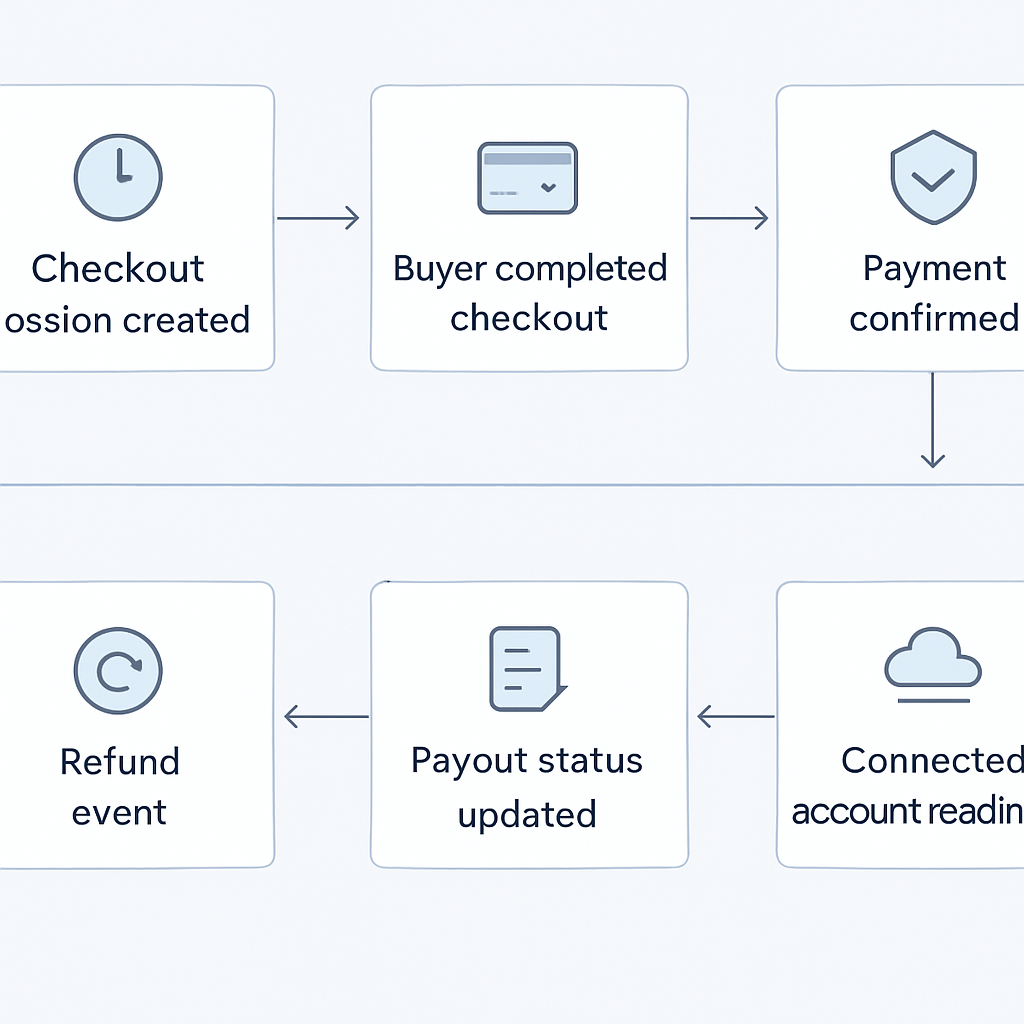
For sellers, the practical value is visibility. Instead of treating payment as a black box, order status can reflect important events such as:
- A checkout session was created
- A buyer completed checkout
- Payment was confirmed
- A checkout session expired
- A refund event occurred
- A connected Stripe account requires attention
- Payout status changed
Webhook status does not remove the need for clear seller operations. Sellers should still monitor orders, delivery configuration, buyer messages, disputes, and refunds. But webhook-based updates help the marketplace keep the transaction record aligned with payment events.
Step 5: Plan delivery timing for one-time purchases
One-time purchases are common for AI prompts, templates, workflow files, automation packages, setup guides, API access instructions, and fixed digital deliverables.
On QbitMarketHub, one-time purchases can use a protected marketplace flow where the seller share may be held during a review window before release to the connected seller account. This structure is designed to give buyers time to access delivery and raise an issue from Orders before payout release.
For sellers, this means delivery timing should be ready before the product goes live. Do not wait until after payment to decide how the buyer will receive the product.
Common delivery options can include:
- Internal delivery instructions
- External delivery URLs
- Secure deliverable files or folders
- Temporary signed access links for private files after payment
A strong one-time purchase listing should answer:
- What does the buyer receive immediately after payment?
- Is there any manual setup step?
- How long does setup usually take?
- Are there prerequisites, such as tools, accounts, or API keys?
- What is excluded from the purchase?
- What should the buyer do if delivery access does not work?
The more precise the answer, the easier it is for buyers to decide whether the product fits their needs.
Step 6: Plan delivery timing for subscriptions
Subscriptions are different from one-time purchases because the buyer is paying for ongoing access, recurring value, or continued service. QbitMarketHub can support recurring subscriptions using Stripe Connect subscription transfer data.
A subscription listing should be especially clear about what continues after the initial checkout. For example:
- Is the subscription for access to an AI tool, workflow, API, or update channel?
- What does the buyer get during each billing period?
- Are updates included?
- Is usage limited?
- Are there onboarding steps?
- What happens if the buyer cancels?
- How is access managed after payment?
For recurring AI products, delivery is not only “send the file.” It may involve access instructions, ongoing credentials, periodic updates, or external systems managed by the seller. QbitMarketHub can help structure checkout and order tracking, but sellers still need to define the operational promise behind the subscription.
Avoid vague subscription claims such as “full automation included” unless the listing clearly explains what that means. Buyers should understand both the product value and the limits before they subscribe.
Step 7: Use secure deliverables when file access matters
Many AI products include files: workflow exports, prompt libraries, documentation, template bundles, automation blueprints, or setup assets. QbitMarketHub supports secure deliverable files stored privately, with buyers receiving temporary signed access links after payment.
This can be useful when sellers want to avoid exposing public file URLs before purchase. It can also make the post-purchase experience cleaner because buyers can access delivery from the marketplace order flow.
Before attaching deliverables, check that:
- Files are final or clearly versioned
- File names are understandable
- Instructions are included where necessary
- The buyer knows whether updates are included
- External dependencies are documented
- The refund policy matches the nature of the digital product
Secure file delivery helps with access control, but it does not automatically prove product quality or buyer fit. Sellers should still make listings accurate and practical.
Step 8: Define refund and dispute expectations before launch
Marketplace trust depends on what happens when something goes wrong. QbitMarketHub allows buyers to open a dispute from Orders before payout release, and open disputes can pause seller payout release.
This makes refund and dispute clarity important. Sellers should publish a refund policy that matches the product type and delivery model.
For example, a seller may need to clarify:
- Whether refunds are available after secure file access
- Whether setup issues are handled through support or refund review
- Whether custom work is included or excluded
- Whether subscription access can be canceled
- What evidence or explanation helps resolve a dispute
Do not rely on a hidden policy. Buyers should be able to evaluate refund expectations before they pay.
One-time purchase vs subscription: operational differences
Here is a practical comparison for sellers preparing payout readiness and delivery timing.
| Area | One-time purchase | Subscription |
|---|---|---|
| Buyer expectation | Receives a defined digital product or access package | Receives ongoing access, service, updates, or recurring value |
| Checkout model | Single payment through Stripe Checkout | Recurring billing through Stripe Checkout and Stripe Connect subscription handling |
| Delivery timing | Usually immediately after payment or after a stated setup step | Initial access after payment, then continued access according to the plan |
| Payout consideration | Seller share may be held during a review window before release | Subscription transfer handling depends on recurring setup and connected account status |
| Dispute risk | Often tied to deliverable access, mismatch, or setup expectations | Often tied to ongoing access, cancellation expectations, or service continuity |
| Listing clarity needed | Exact deliverables, file access, setup time, refund policy | Billing period, access rules, cancellation expectations, ongoing deliverables |
Both models can work for AI products. The right choice depends on whether the buyer is purchasing a finished asset or ongoing value.
Seller payout readiness checklist
Use this checklist before publishing or promoting a QbitMarketHub listing:
- Connect Stripe through the seller workflow
- Complete any required Stripe verification steps
- Confirm connected account readiness where available
- Import or create Stripe products and active prices
- Match pricing to the correct QbitMarketHub listing
- Choose one-time or recurring purchase structure intentionally
- Add accurate product category, use case, and setup time
- Upload relevant product media or demos if available
- Configure delivery instructions, external URLs, or secure deliverables
- Write a clear refund policy
- Explain delivery expectations after payment
- Review buyer-facing seller profile information
- Monitor Orders for checkout, payment, refund, dispute, and payout status
This checklist does not guarantee a sale or prevent every issue, but it can help sellers launch with fewer avoidable gaps.
Buyer-facing details that support marketplace trust
Seller payout readiness is partly invisible to buyers, but the buyer experience is not. Buyers are more likely to evaluate a product seriously when the listing gives them enough information to compare options.
Strong QbitMarketHub listings often include:
- Clear product title
- Specific use case
- Practical outcome description
- Setup time estimate
- Pricing transparency
- Seller information
- Demo or preview materials when relevant
- Delivery expectations
- Refund policy
- Support boundaries
- Product fit guidance
The goal is not to overpromise. The goal is to help the right buyer understand whether the product is suitable before checkout.
Common payout readiness mistakes to avoid
Publishing before Stripe verification is complete
If Stripe requires more information, payouts may be delayed or unavailable until the account issue is resolved. Complete verification as early as possible.
Using unclear delivery instructions
A buyer should not have to guess what happens after payment. If delivery depends on an external tool, account, or manual onboarding step, state that clearly.
Treating subscriptions like file downloads
A subscription needs ongoing access logic. Explain what continues, what renews, and what stops if the buyer cancels.
Hiding refund expectations
Digital AI products can be complex. A clear refund policy helps reduce confusion and supports better dispute handling.
Overstating product outcomes
Avoid guaranteed revenue, guaranteed automation results, or guaranteed business outcomes. Describe what the product is designed to help with, what is included, and what the buyer needs to provide.
FAQ
What is QbitMarketHub seller payout readiness?
QbitMarketHub seller payout readiness means a seller has connected Stripe, completed required verification steps where applicable, configured product pricing, and prepared the listing and delivery flow so purchases can be processed through marketplace checkout.
Does connecting Stripe guarantee immediate payouts?
No. Payout timing can depend on Stripe account status, verification requirements, the purchase type, marketplace review windows, disputes, refunds, and other payment status events.
How does QbitMarketHub use webhook status?
QbitMarketHub uses webhooks to update marketplace records for events such as checkout status, paid orders, expired sessions, refunds, payout status, and connected account readiness.
What happens after a one-time purchase?
After payment, buyers can access configured delivery options such as internal instructions, external delivery URLs, or secure deliverable downloads. For one-time purchases, the seller share may be held during a review window before payout release.
How are subscriptions different from one-time purchases?
Subscriptions involve recurring billing and ongoing access or value. QbitMarketHub can support recurring subscriptions using Stripe Connect subscription transfer data, while sellers define the subscription deliverables, access rules, and cancellation expectations.
Can buyers open disputes?
Yes. Buyers can open a dispute from Orders before payout release. Open disputes can pause seller payout release while the issue is reviewed or resolved.
Does QbitMarketHub validate every third-party AI product?
No. QbitMarketHub provides marketplace infrastructure to help sellers publish, sell, deliver, and manage AI products more clearly. Buyers should still evaluate product fit, seller information, demos, reviews, pricing, delivery expectations, and refund policies before purchasing.
Soft CTA: prepare your AI product listing for checkout
If you are building a practical AI product, workflow, template, prompt pack, automation, API, or agent, QbitMarketHub can help you publish a buyer-ready listing, connect Stripe, configure delivery, and sell through marketplace checkout.
Sell AI products with Stripe Checkout
Internal-link suggestions
- Add this article to a Marketplace Trust resource hub for sellers preparing checkout and payout workflows.
- Link from seller onboarding content with anchor text such as Stripe Checkout setup for AI product sellers.
- Link from product listing quality guides with anchor text such as create buyer-ready AI product listings.